Listen to this post NOW on Beyond Everything Radio!
Most people know the story of Lazarus. He was a close friend of Jesus and the brother of Mary and Martha with whom Jesus was very close. When Lazarus was on his death bed, Jesus intensionally delays going to him for a couple days. When Jesus arrives, the town and family have been mourning Lazarus’s death for four days, and bemoaning that Jesus wasn’t there to heal him. Then comes this little dialogue between Jesus and Martha:
“Martha said to Jesus, “Lord, if you had been here, my brother would not have died. But even now I know that whatever you ask from God, God will give you.” Jesus said to her, “Your brother will rise again.” Martha said to him, “I know that he will rise again in the resurrection on the last day.” Jesus said to her, “I am the resurrection and the life. Whoever believes in me, though he die, yet shall he live, and everyone who lives and believes in me shall never die. Do you believe this?” She said to him, “Yes, Lord; I believe that you are the Christ, the Son of God, who is coming into the world.” (John 11:21-27)
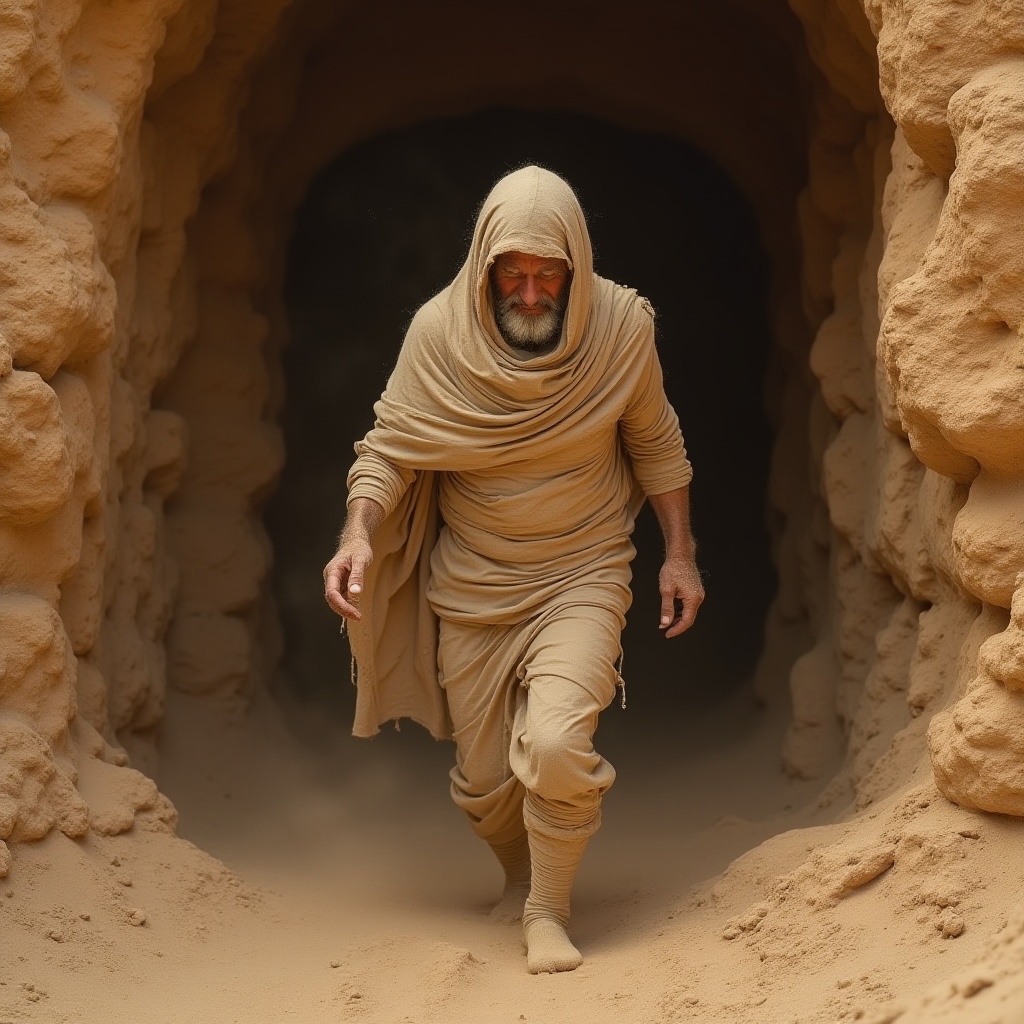
Next, Martha gets Mary and along with Jesus they all weep while the town watches Jesus offer a prayer of thanks to God and then He calls for Lazarus to come out of his tomb, which he does. This causes a rift among those who witnessed it. Some immediately believed that Jesus was the promised Christ of Hebrew scripture, while the religious reported the events to the High Priest and began plotting his death along with Lazarus. This sets up the last days of Jesus’ life and ministry.
John’s gospel is the only recording of Lazarus’ resurrection. Martha’s comment: “I know that he will rise again in the resurrection on the last day.”(v.23), captures something that John says five times in his Gospe: “…and I will raise him up on the last day.” Contemplating this “Last Day” allows us to re-discover Jesus as our resurrection and life.
Only John uses this term “the last day.” Since dispensationalism dominates modern evangelical thought, this term is lumped together along with the term “last days” into a pre-tribulation, pre-millennial eschatology where these texts are understood only in some future dispensation.
So how can the Last Day refer to a future end of this world when Jesus’ claim to be the resurrection and his act of resurrecting Lazarus necessarily means that they had all come to the Last Day?
In this series, I’ve shown how Jesus uses this term “eisersomai” in almost all teachings about the Kingdom of God. It’s an idiomatic figure of speech which means the “coming into knowledge”, the entering into, joining in, becoming aware, or waking up to something which we were oblivious to before, and it’s written in a tense which indicates a state of ongoing present reality. When bible teachers associate this term with the term “parousia” (royal arrival, depicting a literal physical appearing, showing up) they aren’t overreaching. However, whereas dispensationalism’s assumption places the physical arrival of Christ two-thousand years later (making this irrelevant to Jesus’ hearers), my thesis places the “Last Day” as the moment we experience (are resurrected into) the Kingdom God.
This means the Resurrection on the Last Day has two meanings:
- Literal Resurrection: The Kingdom of God is another place distant from earth which is entered upon death or the end of the world, whichever comes first.
- Spiritual Resurrection: The Kingdom of God is a dimension here, now that is pressing into and creating our lived experience. We enter (eisersomai) this kingdom by waking up to this spiritual reality in and as our physical reality, i.e. Christ the resurrection is the power behind our rising up in God. The bodily return of Christ (parousia) is Jesus in and as our life. Jesus becomes our Last Day the moment we discover our “death doesn’t last forever”.
When Paul says in Ephesians 2:1: “You were dead in your trespasses and sin…” he is clearly speaking of being spiritually dead. He then explains how we are spiritually resurrected by the grace and love of God.
“But God, being rich in mercy, because of the great love with which he loved us, 5 even when we were dead in our trespasses, made us alive together with Christ—by grace you have been saved— 6 and raised us up with him and seated us with him in the heavenly places in Christ Jesus…” (Ephesians 2:4-6)
But this resurrection is not ONLY spiritual. John records Jesus as saying
“…for an hour is coming when all who are in the tombs will hear his voice 29 and come out, those who have done good to the resurrection of life, and those who have done evil to the resurrection of judgment.” (John 5:28-29)
This “Last Day” was fulfilled in Matthew 27:52: “The tombs also were opened. And many bodies of the saints who had fallen asleep were raised.”
We must understand Jesus teaching that “the hour is coming, and is NOW HERE…” (John 5:25) We cannot understand Jesus’ teachings from within a binary framework.
When Jesus shouts: “Lazarus, come out!” (deũro-come to here and now, be present, come present), it was a physical event so far outside of the ordinary, that believing it reorients reality for all witnesses. “I said this on account of the people standing around.” (v.42). The story depicts only one man being physically resurrected, but records many people becoming Spiritually resurrected, as evidenced by their belief. “Many of the Jews therefore, who…had seen what he did, believed in him.” (v.45)
Now let’s hear Jesus words transliterated from the Greek:
“I am the (ánástasis-rising up) and the (zoé- life), the one (pisteúo-faith,trust, think true) in me, even if he/she dies, will live, and ALL those living and faithing in me will not die forever.” (v.26).
“Jesus said to her, “Did I not tell you that if you believed you would see the glory of God?” (v.40)
The scripture is replete with content regarding the resurrection, not only of Christ, but also of all humanity. It depicts both a spiritual and physical resurrection, and the question for us is: “Do we believe it?” Clearly belief (something with which all comers struggle) is where religion has harmed us. Converting to the brand new Christian religion never happens in the Bible, but learning to trust and follow Christ does. No one in this story was worried about where they would go when they died. The physical resurrection is not the one that gets us to heaven, sorry, so it must not be our focus. God raises us up, he first calls us out of our mental, emotional, and spiritual tombs, and makes us alive in Christ.
Therefore, in order to experience Christ as your resurrection upon our physical death, we must first be still and reflect upon where and when in our lives have we heard our name called to come forth? When was our inner self (heart) awakened and through what means? The moment we awaken to discover that all these “means” are in fact Christ…is the moment we experience of our Last Day.
If Christ can be our spiritual resurrection, then we can see how He can also be our very life. And if he exists in and as our physical life, then Christ has come again in the flesh…you and I united in faith, living in and as the resurrected Body of Christ. The life we have then isn’t ours, it belongs to God and exists in God, and that’s how we know that even though our bodies will die, they will be resurrected and yet shall we live.
 Thrive in Exile