Listen to this post NOW on Beyond Everything Radio!
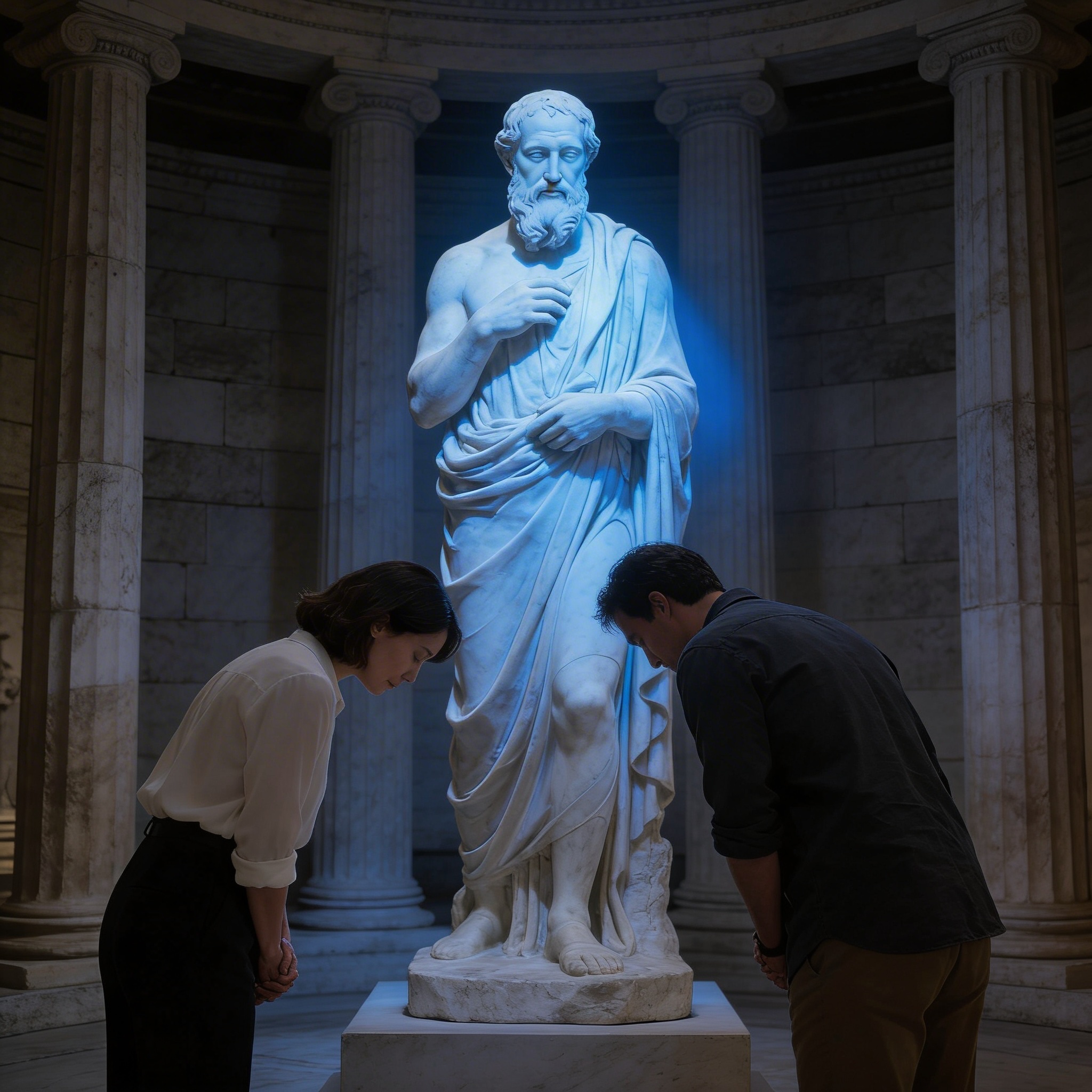
A watershed is like the apex of a roof, directing water in one of two directions. Platonic Dualism is the religious watershed directing a person in one of two realities. Platonic philosophy offers a small cosmology comprised of two fundamental components: the immaterial (soul, mind) and the material (mortal body). The modern mind has so embraced this dualism, that it cannot imagine a reality or a cosmos based upon anything else. This binary way of seeing has entrapped us into a prison from which we argue against our freedom. Politics is perhaps the most visible expression in our modern life, but religion, science, education, sports, and all things social media are constant reinforcers of this myopia.
The binary worldview functions like a light switch. All information that comes to us is routed like a digital code through the watershed of a 1 or a 0, left or right, right or wrong, good or bad, true or false. This immediate bifurcation satisfies our prideful, judgmental mind, by validating our assumptions, biases, prejudices, and desires. It’s a clever delusion whereby we think we are seeing reality, but instead we become further blinded and anesthetized to it. The religious mind is the result of following Plato’s cosmology, and now our world is a pantheon of religio-cultural divisions, awaiting victims who will begin hating the inevitable “other.”
We desperately need wisdom, but that presupposes we are free from Plato’s binary trap. The principle of “non-contradiction” is a logics platitude which is used to claim the higher ground of logic when determining reality. Unfortunately, rather than proving reality, this theorem only validates Plato’s cosmology, not ultimate reality. This theorem claims that something cannot be A and non-A simultaneously. I proved in my book, OBLIVIOUS, how this is actually diminished seeing. Proven by two-people on opposite sides of the earth, each arguing their side of the binary: one is day, and the other is night. It isn’t until we pull back and gain the transcendent perspective that we discover how two opposing truth claims (A and non-A) actually resolve themselves into a bigger truth, by way of a third (ternary) perspective.
This ternary perspective has many names (the third way, trinitarian perspective, the mind of Christ, the Logos, the Tao, freedom from attachments, etc…). The ternary liberates everyone into seeing reality as it actually is. This ternary or Christological reality opens all perspectives to healing, reconciliation, restoration, and unity while also preserving diversity. Last week I showed how this fulfills the technical definition of Salvation, shared by all religions. This becomes our portal through which we can see something religion is forever missing, namely a new way of living and relating within our cosmos. This is what is known as “Experiential Salvation.”
There exists no religion, no political or scientific perspective employing this binary watershed whereby a person can understand the story and person of Christ. In other words, Plato shrinks the biblical Christology. The binary insists Jesus was either only a man (ebionism heresy) or that Jesus was only deity (docetism heresy). Platonic dualism and the principle of non-contradiction force us into one of two heretical views of reality, and thus prevents people from living and relating in our cosmos correctly, thus no “experiential salvation.”
Christology must be greater than one’s cosmology. Plato, and all religions, make Christology subordinate to cosmology.
It’s important to note that there are traditions which understand this “third way” but don’t frame it Christologically, such as Shiva’s third eye in Hinduism, or the Erna in Buddhism known as the “wisdom eye” or in Sufism there is the Mushahada or contemplation which reshapes one’s understanding of reality by way of “oneness” (tawhid) or divine union. I illustrate these traditions because, just as in the Christian tradition, not all subscribers to these religions actually “experience” freedom from the binary, however, it’s vital to recognize that all traditions share not only the transcendent third perspective of wisdom, but also offer a practice (contemplation, meditation, dhikr) that helps each person to become free of pride, and learn humility, patience, and love.
Experiential salvation then is not a byproduct of religion, but of Divine Union, and the ability to see the cosmos from this transcendent christological / ternary perspective (spiritual seeing). Since all religious traditions paid homage to Christ Jesus at his birth, and his claims to fulfill Hebrew scripture as the promised anointed one (Messiah/Christ), then it is reasonable to re-discover this Christological perspective from the teachings of Jesus. Compare how different this is to modern Evangelicalism which invalidates all other traditions.
The true light, which gives light to everyone, was coming into the world.10 He was in the world, and the world was made through him, yet the world did not know him. 11 He came to his own, and his own people did not receive him. 12 But to all who did receive him, who believed in his name, he gave the right to become children of God, 13 who were born, not of blood nor of the will of the flesh nor of the will of man, but of God.14 And the Word became flesh and dwelt among us, and we have seen his glory, glory as of the only Son from the Father, full of grace and truth.” (John 1:9-14)
This is so insightful. The light of Christ lights everyone, but not all will honor or receive this light. Even the most religious of his day, those who should know better, didn’t acknowledge him. Yet everyone, of all traditions, who receive him, he gives them (hezousias) the authority, or in other words, he frees them from the (hezousias) institutional powers that belong to Satan (Luke 4:6).
This being born of God is not something that comes by birth, or by religion, but by God Himself. Think about this. So how do we receive Christ? Evangelicalism says we must say a prayer and invite Jesus into our heart. It also says that we must leave our religions and join the Christian religion, but that is not what the bible says. We receive Christ when our mind becomes free from Platonic binary thinking. How? Because the claim that Jesus is born of God, and is also born of man requires a transcendent third perspective. The binary forces a heresy upon us. The ternary perspective opens us up to receive the Christological cosmology.
Jesus told a beloved religious leader, Nicodemus, that he must be born again (John 3:1-15). Had religion of any kind been the means of salvation, he would have pointed Nicodemus to double down on religion. Nicodemus’ mind was stuck in a binary and not free to see spiritually, so he struggled at first to understand Christ’s invitation. This is where we find most of our world today. Religions have co-opted salvation as a commodity that each exclusively possesses, but none of that is revealed in scripture or Jesus would have said to join one. The soteriology of Jesus is freedom from religion (freedom from the binary) so that we can experience, here and now, divine union (kingdom of Heaven) by way of seeing the world with spiritual eyes.
It’s time we look closer at the message of Christ and realize how it doesn’t divide (krino- judge) the world by the binary of religion, but by those with the spiritual eyes to see, and spiritual ears to hear the transcendent perspective.
“For there is no distinction between Jew and Greek; for the same Lord is Lord of all, bestowing his riches on all who call on him.” (Romans 10:12)
This is proof Paul’s salvation is not limited to one tradition, but “all are justified” in the cosmological Christology.
“And he made from one man every nation of mankind to live on all the face of the earth, having determined allotted periods and the boundaries of their dwelling place, 27 that they should seek God, and perhaps feel their way toward him and find him. Yet he is actually not far from each one of us,28 for “‘In him we live and move and have our being’; as even some of your own poets have said, “‘For we are indeed his offspring. (Acts 17:26-28)
If Paul can employ Epimenides’ poem to Zeus as an applicable Christology, we can learn to open our minds, without fear, to Christ’s revelation found in all people’s and traditions…because its there.
“He who has ears to hear, let him hear.” (Matthew 11:15)
 Thrive in Exile
One thought on “Experiential Salvation: Part 2- Plato Can’t Save Us.”