Listen to this post NOW on Beyond Everything Radio!
This series has endeavored to help you recognize and discover the experience of salvation as it is compared to the “so-called” salvation offered by institutional religions. I’ve shown how Biblical salvation cannot be understood nor experienced from a binary framework, it is neither a stairway to heaven, nor a fire insurance policy which delivers people from eternal conscious torture in Hell, and thus our religions, no matter how devout we are, no matter how much faith we place in them, are impotent to save us.
Your feedback reveals the sticking point of belief or faith. Here again, institutional religion in its flavors and denominations has established the bar for salvation along with custodians and bouncers who determine eligibility criteria. The muddy pig slop of theological debate, certitude, and institutional power is completely un-Christlike, and is relished only by other pigs. Scripture is clear, that the chances for experiential salvation for those sucked into the vortex of this pit is dire. There are no souls more lost than religious souls.
Given the freedom to experience salvation, not as a win/lose, good/bad, heaven/hell binary, but as a continuum within a ternary framework, means we are freed from a million theological debates. Can we lose our salvation? Is it “once saved, always saved?” Does God save us? Do we save ourselves? What is repentance? Is the sinners prayer mandatory? Is it solely about substitutionary atonement? All of it ceases to matter from the transcendent perspective because it’s all true. We are already far more saved than we realize, and not as saved as we can be. We are at the same time loved beyond our comprehension, while possessing darkness we cannot appreciate. This is true of everyone at every moment of life.
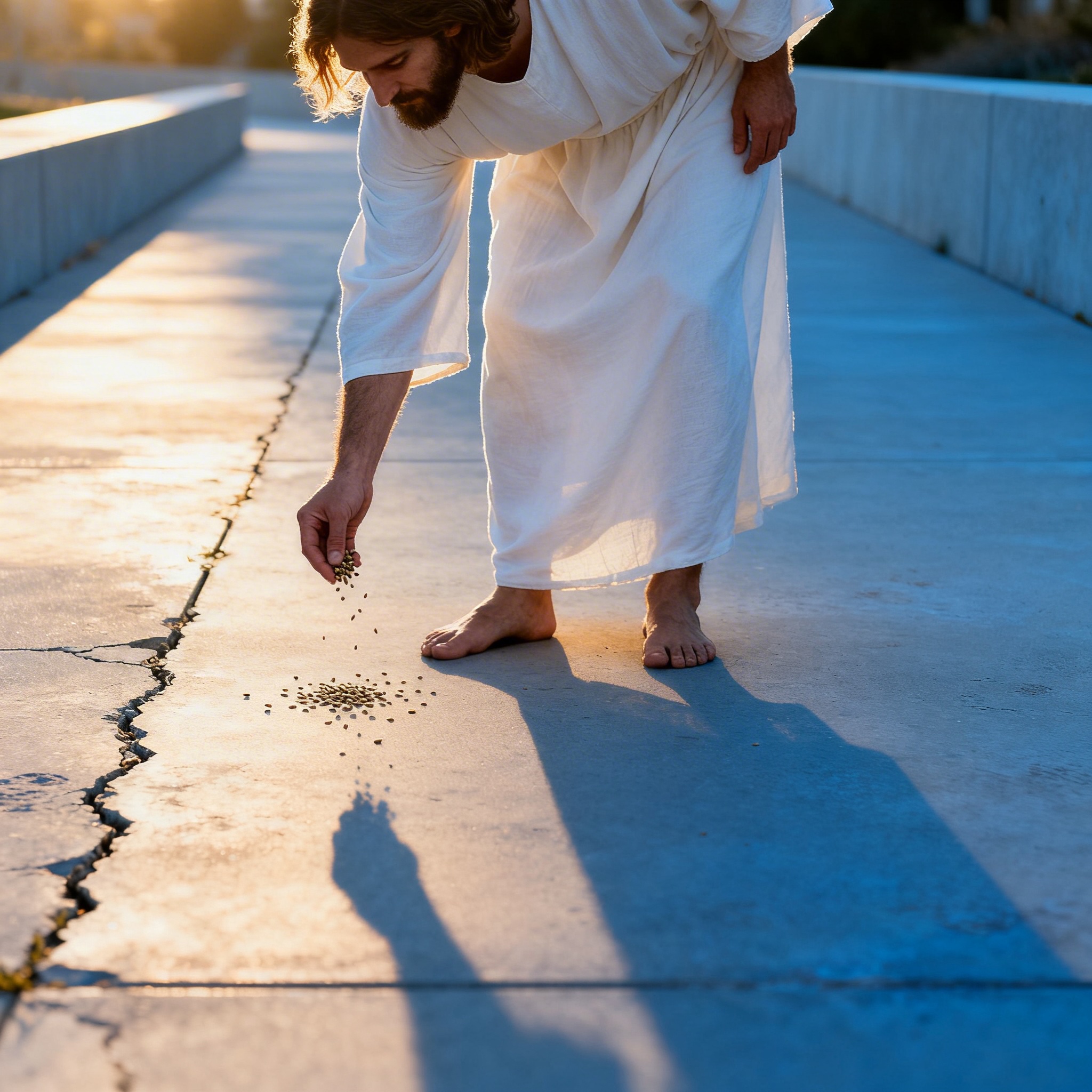
Living from this framework is as nuanced as trying to understand it, but that’s my goal. What this means is that for each person, no matter who we are, or where we are in our life journey of faith, discovery, and experience, we are all found everywhere on the spectrum. The parable of the sower is not about four types of people and only one is saved, it’s four stages of the “Sower” bringing us into the experience of rescue and healing (Luke 8:4). If true, then we must lean into the truth when we encounter it. For example, if the Christological continuum of salvation means that it is as wide and inclusive of every fathomable photon in the cosmos (“Behold, I am making all things new-Revelation 21:5) while at the same time being as narrow as Jesus (“unless you believe that I am he you will die in your sins.”– John 8:24). Salvation is the experience of both ends of the wavelength.
Freedom from the binary flings us into experiential dependence upon God moment to moment. We cannot rest on our religious affirmations. Even if we tithe, give alms, attend every service, read our sacred texts, pray big, weighty prayers, or even do what we deem are spiritual things, if we are truly honest about the thoughts and intentions of our hearts, if we truly measure the depth of our love for God and His gift of Christ, then we know there is an aspect within us that is so false, so dark, that perfect Truth can never know it.
“Not everyone who says to me, ‘Lord, Lord,’ will enter the kingdom of heaven, but the one who does the will of my Father who is in heaven.” (Matthew 7:21)
Salvation is entirely a work of God, but that work is not an event, it is the entirety of life.
Salvation is recognized by all people as something we need and desire. Everyone places their faith in that which they think will save them. Careers, relationships, likes and subscribers, status, power, money, etc…Each of these give us a modicum of deliverance in this physical, temporal existence, but none of these have the power to deliver us from our death. At some point in everyone’s life, if we are still and honest with ourselves, we recognize our need for this kind (eternal) salvation, and then it’s incumbent upon all of us to “come” to Christ. We come by leaning in to hear what Jesus has said and “faithing” is the action verb of trying it out in life.
“Truly, truly, I say to you, whoever hears my word and believes him who sent me has eternal life. He does not come into judgment, but has passed from death to life “Truly, truly, I say to you, an hour is coming, and is now here, when the dead will hear the voice of the Son of God, and those who hear will live. (John 5:24-25)
“You search the Scriptures because you think that in them you have eternal life; and it is they that bear witness about me, 40 yet you refuse to come to me that you may have life.” (John 5:39-40)
“Jesus said to them, “I am the bread of life; whoever comes to me shall not hunger, and whoever believes in me shall never thirst. But I said to you that you have seen me and yet do not believe. All that the Father gives me will come to me, and whoever comes to me I will never cast out.” (John 6:35-27)
Yes, Christ bore the entire wrath of God on behalf of all humanity (1 John 2:2), and yes, everyone who has sinned, has been justified by God’s grace through he redemption that is in Christ (Romans 3:24), yes, God is not willing that any should perish, but all should reach repentance (2 Peter 3:9), and there are countless scriptures that all point to the love and grace and work of God to save all souls. However, this doesn’t mean we are free from the requirement to come and believe.
“Truly, truly, I say to you, whoever believes has eternal life. I am the bread of life.Your fathers ate the manna in the wilderness, and they died. This is the bread that comes down from heaven, so that one may eat of it and not die. I am the living bread that came down from heaven. If anyone eats of this bread, he will live forever. And the bread that I will give for the life of the world is my flesh.” (John 6:47-51)
The biggest stumbling block is conflating faith and belief. Belief is not enough, James tells us that even demons believe. Our works or deeds are important, they reflect what is happening at the depth dimension within our soul, but even our best deeds are not able to save us. Faith is what saves us, and as Paul puts it: “…this (faith) is not even of ourselves.” (Ephesians 2 :8). Faith is the gift of God, but it’s not our belief.
Faith is an action verb. Faithing is the only way faith works. Faith is pure dynamism, not static theological constructs. Faith is not what we believe, nor is it in what we believe, faith is the experience of God Himself, joined not by our emotions or sentiment, not by our intellect or words, but in the experience of living and knowing, in the evidencing of the unseen and relating to the Unknowable. Faithing is shared by all humanity in all religions as depicted in Hebrews 11. Faithing is the experience of God in and as our own life, while holding in fidelity to all that exists, that at it’s epicenter, our faith is shared coming from and returning to the same source in God through Christ. It’s the golden thread woven through all life.
If Abraham were alive today, would he be saved according to evangelicalism? No. Would Judaism say he’s saved? No, he predated the law. If Abraham’s faith (which has more in common to paganism with his inclination toward child sacrifice) is the grandfather of all of our faith, and it isn’t based in any religion, but in the fact that this “other” voice called him and the gift of faith caused him to follow his awakened heart, then faithing today should have a universal inclusion which aligns with the corpus of sacred texts, while also possessing the specific trust that it is Christ Jesus who makes such inclusion possible.
Faithing is the transcendent ternary experience of gospel freedom.
Faithing is the experience of salvation, and it is exactly the same for all of us, while at the same time it is completely different for every soul who has ever lived. Once we are awakened to this experiential salvation, the Kingdom of God becomes visible within every particle of the cosmos.
 Thrive in Exile