Listen to this post NOW on Beyond Everything Radio!
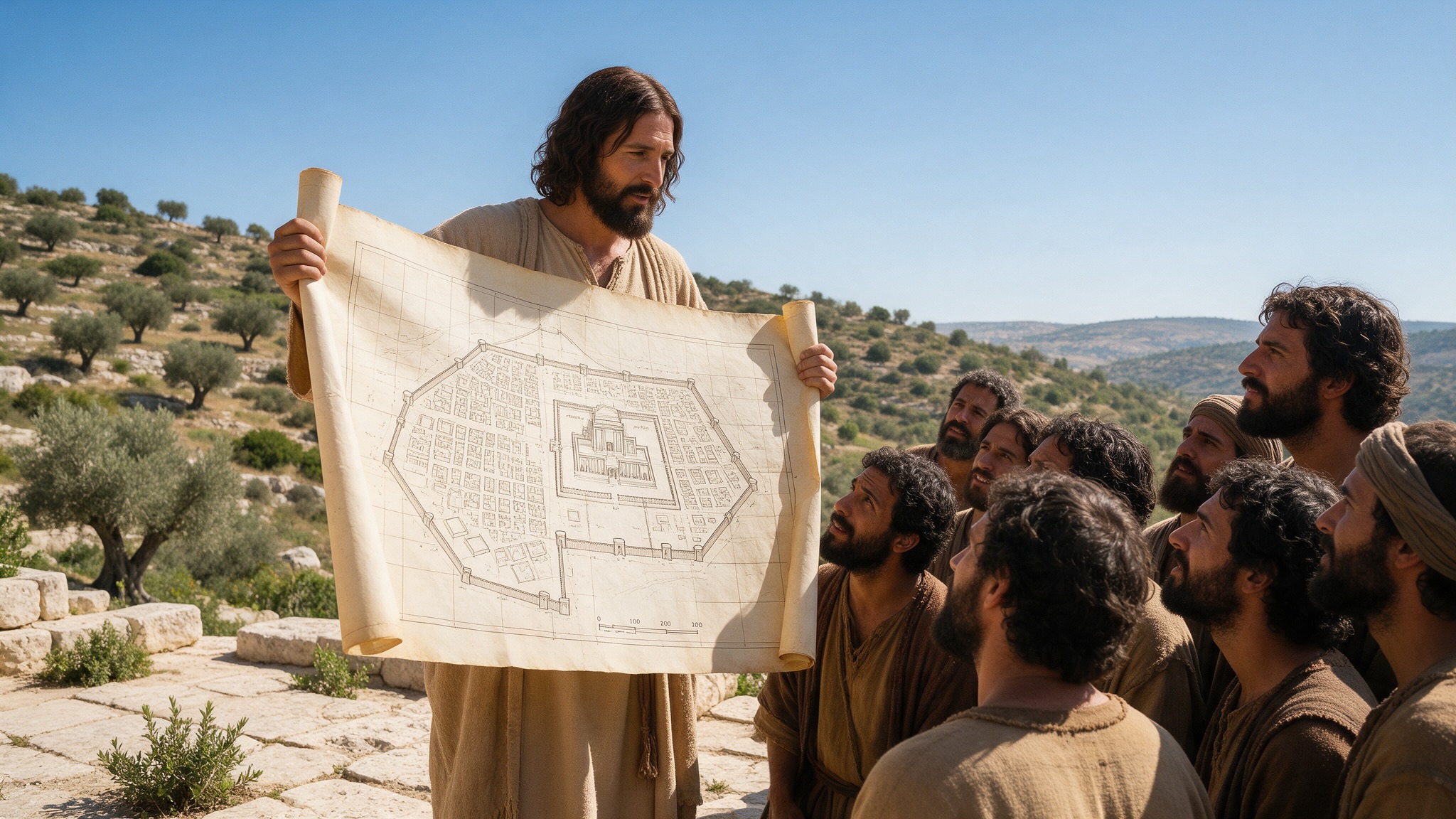
This series has explored an important section of Matthew’s gospel from 16:13-18:20. Prior to this verse, the term “Church” (ecclesia) is not mentioned in scripture. This passage follows a Jewish oral tradition and I believe includes a fairly obvious “chiastic structure.” In Jewish thought, the punchline is delivered first and then supporting material encircles it and the thought concludes with the same punchline. Thus, these two chapters are indicative of Jesus’ blueprint for His Church, which as we’ve seen is a people, a gathering of Christ followers, not a building, not a business, not an organizational structure.
I’ve shown how our contemporary church organizations have drifted quite far from Jesus’ blueprint and have become earth evacuation business franchises, not earth restoration communities that permeate every nook and cranny of society with light and salt (influence and preservation). This means that the modern church is failing in its mission because it has adopted an evangelism where heaven is expanded by gaining converts to the idea that heaven exists after we die, rather than expanding heaven here and now by way of Christ living among us. The broken state of the Church exists precisely because of what we permit and prohibit.
18 Truly, I say to you, whatever you bind on earth shall be bound in heaven, and whatever you loose on earth shall be loosed in heaven. 19 Again I say to you, if two of you agree on earth about anything they ask, it will be done for them by my Father in heaven. 20 For where two or three are gathered in my name there am I among them.” (Matthew 18:18-20)
The first of these bookend passages was in 16:19 and concludes here in 18:20. This verse wraps a bow around the centrality of Jesus’ Church, namely that “his body,” exists where two or more “agree/match” on any “undertaking/event” then “whatever they ask, demand, require” will “happen, come to exist” from Jesus’ Father because Christ himself exists in their “midst/among/in the middle of” them.
If we were to strip the Church down to it’s essential frame, it exists as a relation (not a construct) between to Christ followers. Everything beyond that is personal preference. Not necessarily bad, but essentially unnecessary. The experience of Christ and his Heaven, existing in the midst of human relationships is entirely complete in its most basic form. Even in the smallest of human interactions, agreement has both power and authority to produce world altering results as a benevolent gift of God. The True Church doesn’t require a priest (Jesus is our high priest), nor a building (the church is a people), nor a particular day of the week (man is not made for the sabbath). Jesus Church has no tithe, no building fund, no worship band, not paid staff, no corporate mission, no human hierarchy of power, no incorporation, no tax deduction, no fog machine, no children’s church, nothing of which we have all become convinced is holy.
Jesus’ Church doesn’t require seven sacraments to confer grace upon this embodied union. There aren’t even two. The baptism is not of water, but of the Spirit of God and the Lord Himself is the bread of life…our life where Christ is consumed and displayed. Christ Himself is our sacrament, He confers the grace of God upon us. The immediate power of God replaces political, racial, religions, economic, and social power. Any two can be in a coffee shop, hiking on a trail, sitting on beach, on a cruise, a chairlift, in traffic, in orbit, in combat, and anywhere we exist. Jesus’ Church requires no permit, no building, no loans, no tithing, no land. It has no boundary, no geography, no citizenship of any country, and no force on heaven or on earth can stop it, prevent it, or contain it. It has no denomination, it has no doctrinal statement, there are no dogmatic distinctions, it has no rules of exclusion and the only criteria for inclusion is a trust that we are each guided by God to love and serve one another.
So why isn’t Jesus’ blueprint for Church widely embraced? Paul would ask: “Who has bewitched you?” Why would any of us be guilted into spending our money on the superfluous nonsense and distractions of essentially an entertainment business? Why would we abdicate the inner authority of Christ for the authority of a full-time staff who, just like a tax-collector assesses our ability to give and manipulates our emotions and our labor so that they don’t have to work along side of us? If 99% of what we call church is culturally contrived, then why are we so afraid of a healthy self-criticism and necessary deconstruction which will bring us closer to the vision and mission Jesus had in mind?
I’m often accused, by pastors and church members, that I am down on the Church, that I’m trying to love Christ and not His Bride. This is NOT the case. It is my love of the Church that causes me to seek her reform. If any pastor can prove to me that their version of the Church most optimally represents Christ’s blueprint, I’ll immediately join. However, the evidence that this has NOT taken place is that no two churches, yet alone all of them, collaborate in any given city. They all compete for money, power, and share of voice.
I’m convinced that the Sunday Big Show has so eclipsed Jesus’ blueprint for His Church and that this culturally contrived earth evacuation business has so high-jacked our lives, that liberation from it seems sinful to us. We are so far off from Jesus’ design, that virtually no one leading these churches is willing to relinquish his or her social, religious, and economic power for the sake of Christ Himself. Thus, the so-called church is impotent and lacks the power to truly transform the world. It’s fair to ask, where is the transformation of our world given that there are 25 times more churches than Starbucks?
The answer is that we no longer believe this passage. We no longer believe that Christ and Heaven are in our midst. We no longer see ourselves as permitting something in heaven by permitting it here on earth. In other words, the world the church now despises is the world the church permitted and without realizing it, the world has become our heaven which we also despise so much that we insist on evacuating it when we die. The Church has forsaken its mission as Christ infused culture creators, and permitted evil while prohibiting Christ’s power to flow through us. It’ has become a hideout for thieves, who heap up burdens and tax violence on others.
I know this sounds like a very stern rebuke or prophetic message to modern religion, and it is. I’m not just standing on the outside throwing stones. I’ve served for 25 years within the machinery working in the system. I also offer an alternative and am eagerling seeking collaborators if anyone is so inspired.
These words are an echo of Jesus’ disdain for what religion became in His day, and they come with a loving reminder that we each have a blueprint that is as simple as two-people united in faith. We are each free and empowered to trust Christ to lead us out of the bondage of religion (even the Christian religion), and into the freedom of his body, his people, his Church. We bring heaven about by what we permit and prohibit. This means our choice each weekend is a vote for the cultural business franchise, or for community of faith. Yes, the latter can and does exist within the former, but the former is not required for the latter. This means your time, talent, and treasure are not required for the organizational structure, we are not asked to give to make institutions work, we are to give to those in our sphere who would be blessed by our resources. If the machine fails because we don’t pay for it, literally nothing happens to Jesus’ true church.
Think about this, and then freely and in power begin to bind and loose the Heaven Christ puts within you.

