Listen to this post NOW on Beyond Everything Radio!
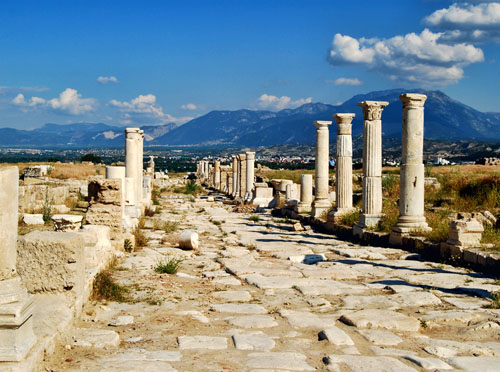
Modern Turkey is where the ruins of the ancient city of Colossae exist. Like all cities in the ancient Roman Empire, there is a rise and subsequent fall which coincides with religious, political, and geographical realities, and Colossae is no different. It was a city of around 25,000-30,000 people and was known for its textiles, particularly purple wool, which would signify that it supplied royalty and leaders with its products in the 1st century. Later in the 5th century, it was known for its natural springs and lore developed around Michael the Arch Angel having a presence there. For our study, we will focus upon the community of Christ followers, likely founded and led by Epaphras, a disciple and co laborer of Paul. The demise of the city was said to be due to an earthquake from which they never fully recovered despite great efforts.
Two Challenges:
- The first challenge surrounds the sources trying to shed light on Paul’s letter to the Colossians, is that the historians are largely outsiders to the Christian faith and thus have zero reference points to the mind of Paul, his life and ministry, and thus his Christology and Cosmology. This means the church in Colossae is ‘observed’ from afar, and these observations import huge assumptions.
- The second challenge surrounds the modern Christian teachers and preachers, who unlike historians, do have experiential knowledge of the Christian Gospel, but because of two thousand years of church history, end up reading this book through the lens of the modern Christian Institutional religion, and not through the lens of a first century Christ follower.
In this study, I will endeavor to avoid both pitfalls by holding fast to Paul’s lived experience as a post-resurrection, Christ follower. This means that his Christology is more similar to the modern mind than those of Jesus’ disciples, and that this Christ experience has resulted in his deconstruction from institutional religion. This is the lens through which we can see in all his works, his christology, cosmology, and anthropology, and finally his ecclesiology without reading into them doctrinal assumptions.
Syncretism: combining or merging of distinct religious beliefs.
Gnosticism: A belief or philosophy that special knowledge (gnosis) can come to spiritual people and that this knowledge has a greater authority than tradition, and that it has the power to save.
The doctrinal assumptions that continually pop up in historical reviews are that of syncretism and gnosticism. Both of these are bad words in modern evangelicalism and institutional frameworks like Catholicism. It doesn’t take a scholar to see through this very thin veil. I am not advocating for either of these philosophical approaches, but I point them out because I am convinced these have become the “straw man” that religion hides behind because Paul’s words to the Christ followers in Colossae are perhaps some of the most deconstructive to religion. Therefore if religion shapes the lens in such a way that the Christian religion can throw stones at syncretism and gnosticism, then it won’t have to recognize how painfully obvious its own existence stands as affront to the supremacy of Christ to which Paul points his readers.
“See to it that no one takes you captive by philosophy and empty deceit, according to human tradition, according to the elemental spirits of the world, and not according to Christ.” (Colossians 2:8)
Paul does seem to tackle the heresy of Docetism (the belief Jesus only appeared to have a human body) which aligns very well with Paul’s rejection of Platonic dualism, and his ternary framework for his cosmic Christology. Yet no matter how much a modern believer claims to understand Paul’s theology, it’s almost impossible to find modern biblical scholars who don’t repatriate Platonic binaries back into Paul’s teachings. To me this makes the impetus to teach Colossians that much more important for modern ears, because it may actually be the first time many of us hear it.
The supremacy of Christ is not a theological attestation. It is not a dogma, nor a tenant of belief. It is first and foremost an experience, and thus experiential knowledge (true gnosticism) becomes a vital component for the measuring line of what is ultimately the heresy Paul is decrying. Secondarily, the supremacy of Christ is wrecking ball which deconstructs all religion and opens a cosmic portal through which Christ can be understood a pre-eminent in all things, all traditions, and all people. Rather than the homogenization of different beliefs in a syncretistic fashion, Paul’s Christology reveals how all comers can share both unity and diversity NOT through a monotheistic religious power play, but through the christological work of total convergence and restoration of all things.
“And above all these put on love, which binds everything together in perfect harmony. And let the peace of Christ rule in your hearts, to which indeed you were called in one body. And be thankful.” (Colossians 3:14-15)
Once Paul’s Christology and cosmology are foundational and experienced, he offers this community some life hacks which will create a gravitational vortex of love, which will not only restore those who are presently experiencing the love of God in Christ personally (vertically), but will attract an onlooking city who is over-identified with either political institutions (Rome), or with diverse religious ones (Israel, Greece, Persia, Asia Minor).
This lets us see how the Gospel was not an invitation to an alternative new religion that Epaphras was starting, but the Christological center through which every religion with all of its rituals, traditions, and incantations, were completely unnecessary. Since God has come down to us in Christ and now Christ has returned in His Spirit and body (church) and is living in and as our lives, we simply have no need for a religious apparatus to elevate us up to God. We are all now free in Christ to love one another and get over ourselves.
I invite you to read this four chapter book weekly as I go through it in this series. Pay attention to what emerges in your mind and heart, and compare it to what the original text is saying. In the end, perhaps we too will all become free of religious “knowing” and gain experiential knowledge, which will ultimately change everything.

