Listen to this post NOW on Beyond Everything Radio!
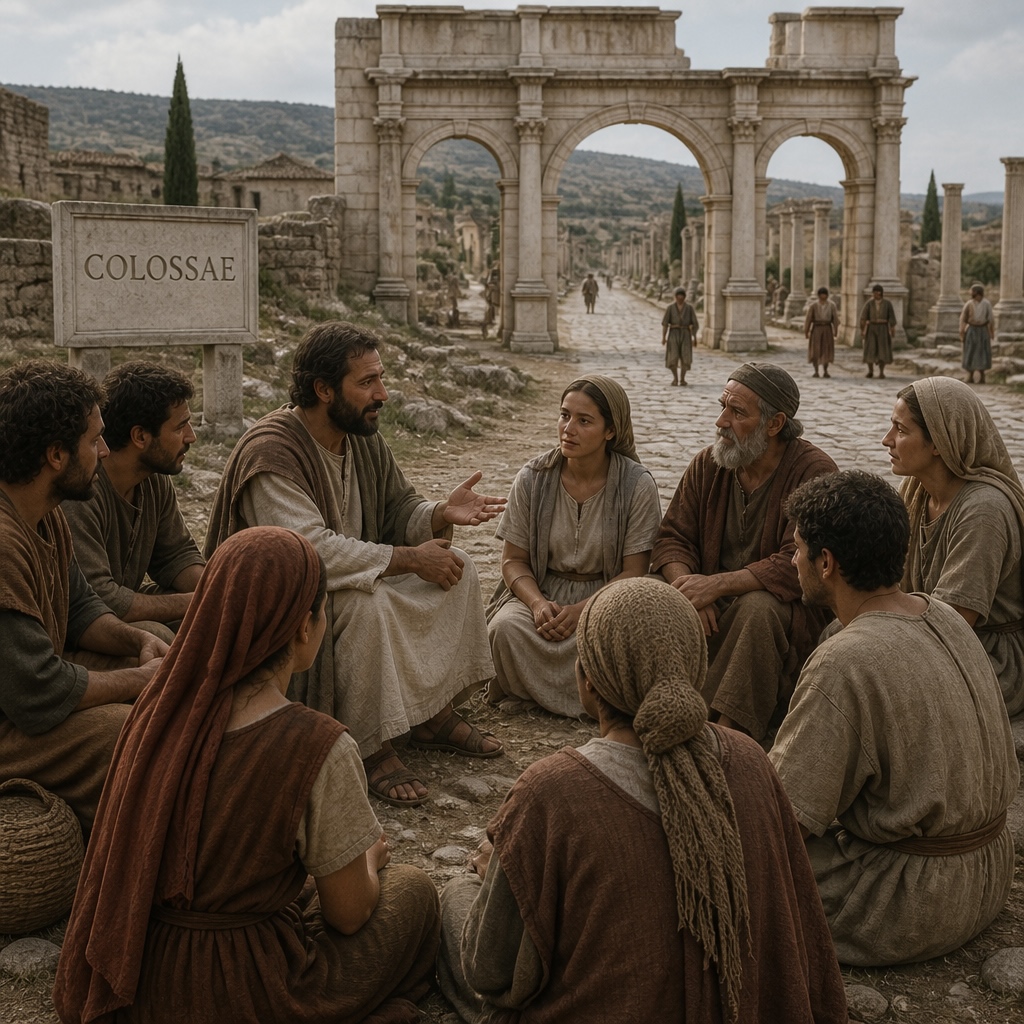
Today we begin chapter two of Colossians, which includes a key transition phrase. It’s helpful to understand that in many Greek manuscripts, verses 1-3 of chapter two are tagged onto the end of chapter one. This indicates that Paul’s “opening statement” of chapter two, are more likely a “closing statements,” functioning like parentheses.
I then want you to know how much (àgōna- struggle, opposition, fight) I experience for you and those in Laodicea and for as many as have not seen my face in the flesh, 2 that their inner beings may be encouraged, being united in love, into all the riches of complete certainty of understanding into the (epignosis) knowledge of the mystery of God, Christ, 3 in whom are (àpókruphoi– secret, unknown, hidden) treasures of wisdom and knowledge. (Colossians 2:1-3)
Just like bookends, Paul’s thesis begins and closes with him revisiting this idea that “super-knowledge” of “secret, unknown” wisdom. Epignosis (super knowledge) of the secret/hidden mystery of God is the goal to which Paul is agonizing, fighting, striving for this people in Laodicea. I’ve shown how church history has claimed that Colossians is a letter combatting Gnosticism, which I should mention has as a core tenant, a “mystical knowledge” or “secret knowledge” as one’s source of authority.
We really must ask how Paul’s letter a rebuttal against something that he so explicitly desires for these people?
My conclusion is that Colossians isn’t about Gnosticism at all. In fact, Gnosticism didn’t exist for another century. Instead, Paul’s desperate appeal to all hearers is to resist institutional authority and remain steadfast in the inner experience and inner authority of Christ to lead everyone in love and humility. By modeling our lives after Christ, we demonstrate Christ is alive and living within us…as us. Paul’s next chapter builds a case not against Gnosticism, but against Platonic dualism and institutional overreach into their freedom in Christ.
The transition sentence emerges in (vs. 4-5) as he summarizes his wordy themes from chapter 1:
“This I say so that no one may (paralogizomai– deceive you with plausible reasons in (pithanologia-convincing speech, well constructed arguments). 5 For I am absent in body, yet I am with you in spirit, rejoicing to see your good order and the (steréoma-firmness, steadfastness) of your faith (trust) in Christ.” (Colossians 2:4-5)
If Paul were alive, this warning would speak directly to our political and media consumption, which is entirely built upon constructed arguments and convincing speech. We are so convinced these are the sources of truth, because we are no longer steadfast in our trust in Christ.
Reflecting on Paul’s life, we know that about ten years earlier, Paul stood at the epicenter of Greek philosophy and deconstructed mythology and Platonic dualism. His teaching at the Areopogus in Acts 17 is a clinic on what Evangelism should be. Instead of converting them to a new upstart religion, he simply completes their belief system, (using their own sacred poem to Zeus written by Epimenides) to point them to the Supremacy of Christ in all things (including the material world) as evidenced by the Resurrection of Jesus. He didn’t invalidate their belief, he revealed how it’s not inclusive enough. Christ’s life, death, and resurrection reorients Greek mythology in the clouds back into the lived experience, validating their anthropology rather than devaluing it.
Now when they heard of the resurrection of the dead, some mocked. But others said, “We will hear you again about this.” (Acts 17:32)
This tangent helps us access Paul’s mind which, now sitting in a Roman prison, is reflecting back on the cultural influences of religious, political, and philosophical institutions of power. For Paul, the gospel is the power that frees all humanity from “exusias” (institutional authority) and the church is the single organizational body (of Christ) whereby (all ‘exusaias’ has been given to Christ-Matthew 28:8) institutional authority belongs only to Christ in God, and not to any human. I’m convinced that this gospel premise aligns with Jesus’ Gospel, John the Baptist’s, the disciples, and Paul’s. Thus, it’s a reasonable conclusion that Paul is agonizing to keep this community free from institutional overreach by grounding them again in the physical embodiment of Christ…the ecclesia.
“because you indeed (paralambano-actively took alongside, received) Christ Jesus the Lord, so (peripateo-trample around, walk, behave) in union with him, strengthened and built up in union with him and (bebaióomai-increase inner strength) in the faith /trust (faithing), as you were taught, (perisseuo-urged on, chased around, excessing) in thanksgiving.” (v.6-7)
I hope you see how Paul’s language is very embodied. Our union with God through Christ is experienced in and as our life and in community with one another. Paul is agonizing in his appeal to let the inner experience of Christ, remain as their inner authority. Let this sink in. Contemplate this. How many of us appeal to the experience ofChrist as our inner authority, compared to our knowledge of Christ. Or our appetites? Or to external authorities? Or to institutions? Remember this community didn’t have religion yet, nor the bible. If the modern church is to heal and move into conformity to it’s founder, what must change for it’s people? The ecclesia was never to be institutionalized, instead, it was always to remain the one organization that was distinct (Agios- Holy) from institutions of man. The authority of Jesus’ Church is the experience of Christ, NOT the institution man created in His name.
Paul’s letter implies that we must not place our faith in our faith system, but in the inner experience of Christ, living in and as our life. It’s no surprise that institutional power has surpassed this clear message. Individual freedom is a dangerous threat to institutions who depend on control. For the Church, Christ is the head, the sole authority, and His authority is within the individual, where Christ dwells. The goal for Paul is a faith that generates results, is built up, strengthened, rooted in, in union with Christ. Christ following is not a faith in knowledge about Christ, or knowledge about God, it is possessing a “super-knowledge” or experiential knowledge of Christ in God. It’s a big deal, and now we can see why Paul’s message is suppressed and co-opted by religious power.
Anyone can test this. Sit still in a quiet humble posture. Stay silent if we can. Notice how our mind can’t or won’t shut up. All those thoughts and emotions are not ‘you‘ and these should have no authority. These are only opinions, limited perspectives, our own ideas, these are crowding out the silence where Christ exists in union with and as us. Once we are able to be still and humble, truly surrendering to the “unknown mystery”, then the experience of Christ unfolds. Out of the darkness, comes light. Out of the silence comes a voice of wisdom and clarity. Out of the distraction comes a convergence. This is Christ, in whom we place our trust. Christ is the means by which our Almighty Father and Creator speaks, and in His tremendous love for us, has removed any barrier to this experience. If we place our faith in what Paul calls “super knowledge” or what I call “experiential knowledge”, no institution will ever rule over us because they will not be able to name us. We will never be enticed by institutions again and we will live free from their overreach.


As usual very inspiring. Thanks!