Listen to this post NOW on Beyond Everything Radio!
**Please consider sharing this post or the podcast with your Pastors, Elders, Deacons, and other church members and explore where the conversation takes you.
Since 2012 my message has remained the same: “Follow Christ…NOT Christianity.” Jesus didn’t start an alternative religion thus when we fall in love with, or over-identify with any aspect of the Christian religion, we make an idol of something that should never have existed had our forefathers been faithful to our Founder’s Word. Yet here we are…2000 years later…deeply entrenched in one of 45,000 Christian denominations, each insisting ours is the right one.
Last week I picked at the painful scabs of our culturally contrived systems and exposed the purest and most simple definition of the Church where the power and presence of Christ is promised to exist, and yet, Jesus’ “ecclesia”(gathering, assembly, church) is no longer desirable by people who claim to love and follow Christ Jesus.
“The word of the Lord is to them an object of scorn; they take no pleasure in it.” (Jeremiah 6:10)
We have fallen deeply in love with our traditions, frameworks, and doctrines and have become addicted to the elixir of religious, social, racial, and economic power that our earth evacuation business franchises provide. Every pastor, and nearly all church members, to whom I’ve brought this subject, has rejected these claim outright. Religion always rejects the prophetic voice throughout scripture:
“For from the least to the greatest of them, everyone is greedy for unjust gain;
and from prophet to priest, everyone deals falsely. They have healed the wound of my people lightly, saying, ‘Peace, peace,’ when there is no peace.” (Jeremiah 6:13-14)
The most common response which brushes off any self-criticism is: “My church isn’t like that.”
So what should the modern church look like? My goal isn’t to establish new rules or even specific tweaks that churches should apply. Since Jesus never set up an alternative religion, it seems unwise to try and recreate one now. Instead, I think each community must take seriously their commitment to their container in relation to the necessary contents. Everything that is piled upon “two or more gathered in my name” is time, resource, and energy going toward a potential idolatry. Yes the business of church is a real idol. Remember, Jesus raged at the moneychangers in the temple who were employing the same mindset we see today, to make sacrificing and worshiping as easy as possible for as many as possible. To test if church is your idol, check how your heart responds to these suggestions.
Jeremiah stood in the courtyard of the temple and delivered the invitation to the cities of Judah to hear the word of the Lord on the off chance that they might actually listen (Jeremiah 26:1-9), the result was that they wanted Jeremiah dead, because he told them things that they were not willing to hear. While I am no Jeremiah, my experience keeps confirming that modern Christians will also dislike this message. Nonetheless, I offer these two trend lines to all who will consider them.
REDUCTION NOT EXPANSION
Success of a church is not its expansion in size, but in its ability to grow depth in its members into Christlikeness. A community of ten people who are mature, Spirit filled, and fully embody the life and love of Christ will have the power to heal, deliver, and redeem more of their community than the entertaining Sunday Big Show which is essentially a concert and a Ted talk.
- Less is more. Instead of each local church trying to be everything to everyone, they need to focus on one thing and begin serving the entire community in that area.
- Reduction of ego, power, staff and services. Instead of building a big “brand” or getting famous, or leveraging marketing, social media, etc… to promote services, chase likes and subscribers, etc…a church should simply forsake competition and marketing and begin serving and self-emptying in its area of gifting. Developing excellence in one or two areas will open the community to collaboration instead of competition.
- Transition to no paid staff. I’m aware of the 1 Corinthians 9:14 “In the same way, the Lord commanded that those who proclaim the gospel should get their living by the gospel.” But it’s also quite evident that Paul is building the case that we should model after him, namely:” But I have made no use of any of these rights, nor am I writing these things to secure any such provision. For I would rather die than have anyone deprive me of my ground for boasting.” (9:15). (I know this is unfathomable to most pastors. It was for me when I had to “get a real job” in order to support my ministry addiction. It can take time so transition over 4-5 years. Any pastor who won’t do the work for free is not in love with the gospel. Plus the more focused a church becomes the less need there is for all the staff.) If you think this impossible, how does the mormon church successfully manage this? It’s clearly possible if there is a will to do it.
DECENTRALIZATION & COLLABORATION
- Moving away from denomination and incorporation. Jesus’ church is not a business. It shouldn’t be someone’s retirement, their means of accumulating wealth. Religious organizations shouldn’t be the wealthiest businesses in the world. (Catholic $73B, Mormon $300B). This is a hard one for the American Mind. Christ is the head of the body of two or more gathered in faith. As more gather, the biblical model is that no one holds anything as “their own” but holds all things in common. Once power aggregates around property and money, the silo of power and resources coopts the head…Christ. People often play lip service to Jesus, but in reality, decisions are financial or business decisions, not ministry decisions. A church that truly trusts Christ as their head, will not seek, nor require any form of affiliation that creates barriers to others.
- Collaboration solves most problems. Collaboration cannot be an ideal. It must replace competition and siloed power among churches. Christ’s body is not a business that must “outdo” others, it is the redemptive community that models exactly how complete diversity exists with total unity. Collaboration is NOT uniformity. It is acceptance. It is the surrender of personal power and need to control. It is a community of faith, that is trust, in Christ and in each other. Why can’t ten churches exist together, each bringing their gifts to bear upon one another, without fighting over distinctive, and without any having to own or control the money, resources, property, or people. This idea is so offensive, so foreign to the modern mind, but it is exactly why the power of God doesn’t exist in most communities.
- Move away from tax-free status. In Douglas County where I live, the loss of tax revenue from the Protestant, Catholic, & Mormon churches is roughly $7-8M. The same population nationally brings in ~$160B in revenue with a cost to the US of $33.6B. Churches use the resources of the State, but do not pay for them in the same way as a regular business. The Non profit status means less oversight, less accountability, and more opportunities for corruption.Most donors do not give enough to surpass the standard deduction, and the motivation for giving to the work should not be to reduce one’s tax responsibility. Jesus said we are to pay to Caesar what is Caesar’s and to God what is God’s. “When it goes well with the righteous, the city rejoices,” (Proverbs 11:10).
It displeased the Lord when Israel asked Samuel to give them a king to rule over them. That was never the design. Jesus’ Church is the microcosm of two people uniting in faith and Christ in their midst. This microcosm is to expand like yeast into the macrocosm by way of the this decentralized, kingless, reign and rule of Christ in the hearts of humanity. This leaven wasn’t intended to create a sub-culture that fights with the culture, but was intended to transform the culture in love and humble service to one another. The Church was never intended to be another institutional power that stood in contention to other institutional powers, it was always the subversive power that no institution could possess, stop, or control. It still is.
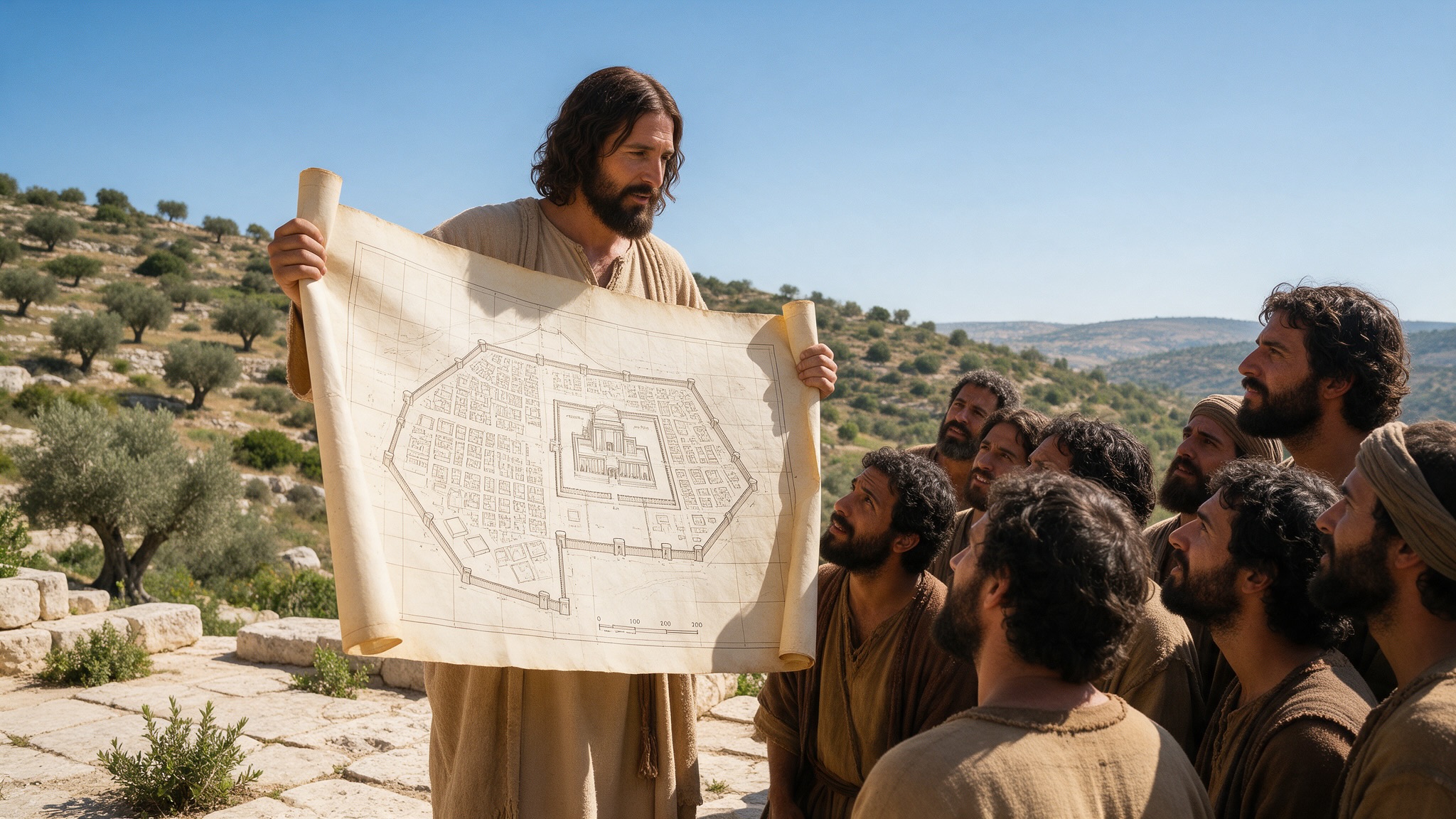
The modern American church has very little to do with Jesus’ true Church, and Christ following has little in common with the religion of Christianity. The modern American Church has become impotent compared to the biblical example. It no longer trusts Christ to be the head of each believer, but insists on confiscating and aggregating power in the way that man has always done it. It fears the freedom of truly free people. If we are to return to the Blueprint Jesus offered, we will have to deconstruct from the kings and institutions that have given us our power and our pseudonyms, and regain the power of God and our true name.
Two people in faith can still usher in the New World.

